Speculative Friction in AI design and governance
<< home | about | blog | story lab | CONTRIBUTE | resources | games | events | subscribe
“The exercise of imagination is dangerous to those who profit from the way things are because it has the power to show that the way things are is not permanent, not universal, not necessary.”
Ursula K. Le Guin,
The Wave in the Mind: Talks and Essays on the Writer, the Reader and the Imagination
The Wave in the Mind: Talks and Essays on the Writer, the Reader and the Imagination
Friction is a leverage point. Our Theory of Change is that expanding the creative capacity for constructive friction empowers people through improved AI literacy, understanding, and choice over how AI systems impact nearly every aspect of our experience. We’re now inviting submissions that explore frictions between people and AI systems in creative and critical ways. What do we mean by frictions? - Get inspired by leading voices in our expert interview series — respond to their provocations and challenges, or tell us about entirely different kinds of (un)constructive frictions that are important to you.
What We’re Looking For
We are especially interested in works that experiment with practical legal fictions or creative provocations that illuminate, exaggerate, and transform tensions in the law, policy, and governance of AI systems.We welcome proposals in one of the formats below:
-
Speculative fiction short stories (1,500–3,000 words)
- Essays or articles (critical reflections, personal essays, or shorter pieces that connect an existing book, project, or body of work to the themes of friction and AI)
- Artworks (digital, visual, sound, or mixed media)
- Design fiction prototypes (user interface, mock-ups, interactive pieces, speculative legal or policy design, or conceptual prototypes)
Submissions should engage with a specific friction between people and AI systems. For example, in the form of:
- Real-world accounts of constructive or challenging frictional experiences
-
Fictional human or non-human experiences of AI systems
-
Social, technological, or ecological interventions
-
Legal or policy re-imaginations
- Or another way of bringing friction into view
What is Legal Fiction?
A legal fiction is a deliberate construct in law where something is treated as true or real for legal purposes, even though it may not be factually so. It functions as a pragmatic device that allows the law to adapt to complex realities without rewriting existing doctrines. For example, the legal notion of a corporation as a person enables it to own property, enter into contracts, and be held accountable in court, even though it is not a human being. Similarly, the concept of environmental personhood extends the idea of legal personhood (traditionally applied to humans and corporations) to rivers, forests, or ecosystems in Nature, by granting them certain legal rights and standing in court. This doesn’t mean that a river is literally a “person,” but that the law treats it as one for the purposes of protection and representation. In this way, environmental personhood operates as a juridical metaphor that enables new forms of environmental governance and accountability.
Guidelines
- Submissions may be new or already existing works that fit the theme.
-
Each submission should include a short description (150–300 words) that situates the work and highlights the frictions it explores.
-
Selected works will undergo a light review by community members. After that, they would be published on the project website and the Substack newsletter.
- Timeline: Submissions will be reviewed and published on a rolling basis.
Why Submit?
Friction doesn’t resolve on its own. By engaging critically with moments of resistance, confusion, or difficulty, we can open up new pathways for agency, accountability, and imagination in AI use and governance.
This call is an invitation to:
-
Share your story, artwork, or prototype with a growing interdisciplinary community.
-
Help expand how we think about “the frictions we want” in designing, interacting with, and governing AI systems.
-
Contribute to a living archive of creative interventions at the intersection of people, technology, and governance.
How to Submit?
Include:
-
Your name and a short bio (200 words)
-
Title of your work
-
Format (story, artwork, prototype, essay)
-
The submission itself (or link to your submission in case it is an artwork)
- A description of the friction it engages with
︎ Contribute Here ︎
Intention and values
Lastly, we share our motivation, intention, and values in putting together this call for proposals. It is a call to experience the adjacent possible through speculative specificity.Speculative specificity: Use the tools of worldbuilding and speculative fiction to create concrete, richly detailed, nuanced, complex future worlds and populate them with compelling characters who have real problems to solve.
Embrace the adjacent possible: A reference to what speculative designers call the cone of possibilities. It is a tool that allows you to ground alternative futures in the present reality.
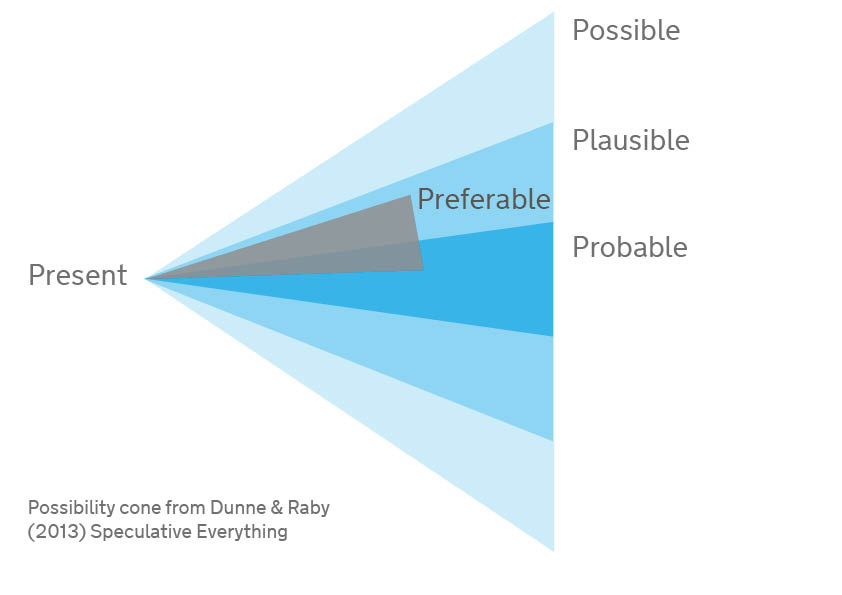
The diagram illustrates potential futures across a spectrum of likelihood and desirability. The probable futures represent the traditional design space of expected outcomes, while plausible futures explore alternative scenarios that remain connected to today's world. Possible futures encompass all extreme yet scientifically feasible scenarios, expanding our imagination beyond current constraints. Preferable futures utilize speculative design as a tool for debating and discussing what kind of future we actually want to create. Beyond the cone lies the realm of pure fantasy.
Science fiction is an important feedback loop with scientific and technological innovation. Because “humans are much better at thinking about the future when we can also feel it, empathizing with future people who are living with the benefits and costs of particular innovations,” - Ed Finn, founder of the Center for Science and the Imagination at Arizona State University. Ed writes about the need for more policy futures: engaging in grounded, structured acts of speculation should become an essential part of every policy process, because doing so allows all to imagine and debate not just how the world could be, but how it should be. Read about his invitation “to step into the free and infinite laboratory of the mind”, through the rules for speculation, to inspire your process in response to the “AI frictions” you want to engage with in your short story.
︎ Contribute Here ︎
Thank You! We truly appreciate your labor of love and contribution to this weird corner of the AI ecosystem. Let’s expand the possibility space in AI design, development, use, and governance!